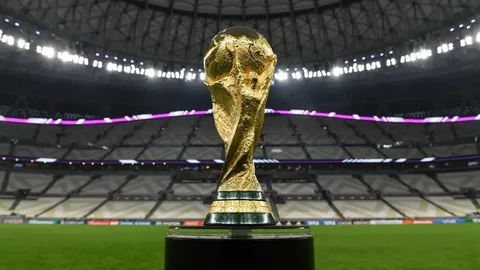
Football’s global stage will shift to the United States capital on Friday, December 5, as FIFA hosts the final draw for the 2026 World Cup, an event expected to combine procedural precision with prime-time entertainment. Held at the John F. Kennedy Center for the Performing Arts, the draw marks the official beginning of preparations for the tournament set to run from June 11 to July 19, 2026, across 16 cities in the United States, Canada, and Mexico.
The 2026 tournament is historic in scope. For the first time in its history, the World Cup will expand to 48 teams, arranged into 12 groups of four. From this expanded group stage, the top two teams in each group will automatically advance. In addition, the eight best third-place finishers will progress to create a 32-team knockout bracket. While 42 nations have already qualified, six spots will be resolved via playoffs scheduled for March 2026.
Format and Seeding: Pots and Placement
FIFA organisers have adopted a four-pot seeding structure to guide the draw. Each of the 12 groups (labelled Group A through Group L) will include one team drawn from each pot. Pot 1 comprises the three co-hosts, the United States, Canada, and Mexico, automatically assigned to lead their groups, along with the top nine ranked sides based on the latest FIFA World Rankings. Pots 2, 3, and 4 will fill the remaining slots, sorted by ranking position.
To preserve geographical balance, FIFA’s confederation rules prohibit teams from the same confederation, except for Europe’s UEFA, which commands the highest number of entrants, from being drawn into the same group. In the case of UEFA, some groups may contain up to two European teams, but no group may include more. The draw committee will enforce these constraints using computer-aided allocation during the ceremony.
Officials will reveal the group composition gradually through a traditional draw consisting of numbered balls drawn from transparent globes. The ceremony is set to last approximately two hours and will be broadcast to audiences in more than 200 countries around the globe.
Hosts, VIPs, and Celebrity Participation
The 2026 draw is designed not only as a sporting event but also as a spectacle. The ceremony will be co-hosted by well-known entertainment figures. International model and television personality Heidi Klum, actor and comedian Kevin Hart, and Hollywood actor Danny Ramirez are set to present the official portion of the draw. Ramirez, celebrated for his work in major motion pictures and deep ties to both the United States and Mexico, will engage football greats and introduce segments of the ceremony.
FIFA has scheduled appearances by several unexpected dignitaries. Among them is former U.S. President Donald Trump, who is expected to attend and play a ceremonial role, including accepting FIFA’s newly introduced Peace Prize titled “Football Unites the World”. High-profile political figures from the co-host nations, including Mexico’s President Claudia Sheinbaum and Canada’s Prime Minister Mark Carney, will be present, highlighting the diplomatic weight of the occasion.
The event also mobilises a selection of sports icons as draw assistants. Notable names expected to take part in conducting the team selection include former football great Rio Ferdinand, baseball star Aaron Judge, American football legend Eli Manning, and NHL legend Wayne Gretzky. Tom Brady and Shaquille O’Neal will also appear as part of the celebrity support team during the draw proceedings.
Entertainment Line-up: A Global Show
To complement the football focus, FIFA has assembled a high-profile entertainment roster, uniting a mix of musical genres and global star power. Renowned classical tenor Andrea Bocelli will deliver a performance during the ceremony, offering a cultural counterpoint to the sport-focused event. International pop icon Robbie Williams, also serving as FIFA’s Music Ambassador, will perform with American singer Nicole Scherzinger in what is expected to be a key highlight of the evening.
Once the official draw concludes and the groups are finalised, disco legends Village People will close the celebration with a performance of their iconic anthem “Y.M.C.A.” Known worldwide for its singalong appeal, the track has also become particularly notable in connection with Donald Trump, having been used frequently during his political rallies.
The entertainment segment positions the draw as more than a sporting draw; it is also a cultural moment demonstrating football’s reach beyond stadiums and into mainstream show business.
Ceremony Schedule and Additional Details
Red-carpet proceedings will feature interviews and commentary hosted by Eli Manning ahead of the main event. The official draw ceremony will begin shortly after midday Eastern Time in the U.S. and is expected to conclude by mid-afternoon.
Following the draw event, FIFA is scheduled to release detailed match schedules, including exact kick-off dates, venues, and fixture times. These details are critical for fan travel planning, tourism coordination in host cities, and future commercial scheduling.
The 2026 World Cup final draw reflects FIFA’s desire to elevate the profile of football in one of its most crucial markets, North America. By combining sport, celebrity culture, and spectacle, the ceremony aims to captivate viewers worldwide. Beyond procedural announcements, this event doubles as a major promotion of the tournament’s unique co-host model and the logistical ambitions of staging a 48-team competition.
As millions of fans prepare to watch the draw unfold, anticipation continues to rise not just for the teams that will compete but also for the blend of football and entertainment on full display. From high-ranking seeded nations hoping for gentler group stage paths to global audiences tuning in for performances by some of the world’s biggest music stars, the 2026 World Cup draw promises to be a defining moment in the build-up to football’s grandest competition.