
In a sudden and alarming development early Sunday, December 7, 2025, Benin witnessed a dramatic escalation of military unrest as a faction of soldiers sought to seize control of the nation’s government. The brief attempt to overthrow the constitutional order prompted the rapid mobilisation of loyalist forces, support from neighbouring Nigeria’s military, and reinforcements by the regional bloc, the Economic Community of West African States (ECOWAS). Within hours, the situation shifted from a dire threat to constitutional order to a reaffirmation of Benin’s longstanding tradition of resisting armed takeovers.
The group of rogue military personnel, identifying themselves as the “Military Committee for Refoundation,” interrupted early morning broadcasts on state television to declare the dissolution of the government. They claimed to have removed President Patrice Talon from power, announcing the appointment of Lt. Col. Pascal Tigri as head of the newly proclaimed leadership. The announcement, although abrupt and shocking, was short-lived.
Authorities later clarified that the uprising was the work of a small contingent of soldiers, acting without the backing of the wider military establishment. Nonetheless, their initial broadcast and seizure of strategic locations, including the state broadcaster and a key military camp in Cotonou, sparked panic among citizens and raised fears of an abrupt return to the era of coups that have disrupted multiple West African nations in recent years.
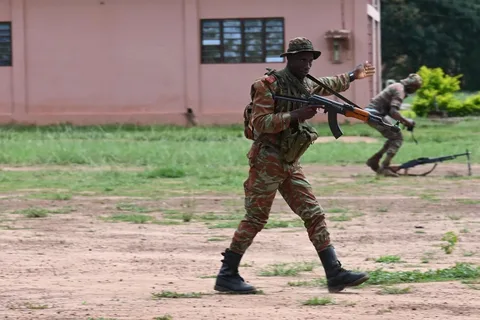
By mid-morning, loyalist forces had begun pushing back decisively. Government officials reported that troops loyal to the presidency, supported by specialised units of the Benin armed forces, moved swiftly to surround and retake positions compromised by the mutineers. The Presidential Guard and other elite units were deployed to secure the capital and protect critical infrastructure.
In a nationally televised address later that day, President Patrice Talon thanked loyal troops for their commitment to preserving stability. He categorised the mutineers as a small band of “adventurers” seeking to destabilise the nation. “Our institutions have stood firm,” the president said, reassuring citizens that “order will be fully restored, and those behind this treasonous action will face the full weight of the law.”
Nigerian Military Intervention and Regional Action
The rapid restoration of control was significantly aided by the timely intervention of the Nigerian military. Acting on a formal request from Beninese authorities and under the endorsement of ECOWAS, Nigeria deployed warplanes and ground troops to support the loyalist forces. This marked one of the most notable cross-border military operations by Nigeria in recent years and underscored the gravity of the situation in Cotonou.
The Nigerian Air Force dispatched fighter jets into Benin’s airspace to counter the rebel occupation of key facilities. These air missions were described as precision operations designed to dislodge the mutineers and prevent further destabilisation. Meanwhile, contingents of Nigerian ground forces, in coordination with Beninese military units, moved rapidly to secure strategic zones, neutralise remaining pockets of resistance, and protect government installations.
Government spokespeople emphasised that Nigeria’s actions were taken at the invitation of President Talon and were aligned with ECOWAS’s mandate to uphold democracy and regional stability. This intervention effectively tipped the balance in favour of the loyalist forces and limited the duration of the crisis.
In addition to Nigeria’s contribution, ECOWAS announced plans to position a standby force in Benin to prevent any resurgence of violence and to provide a stabilising presence as the nation prepared for a presidential election in April 2026. Troops from other member states were on standby, with contingents expected from countries including Sierra Leone, Côte d’Ivoire, Ghana, and others. The African Union also condemned the coup attempt, reiterating its stance against unconstitutional changes in government.
Domestic and Political Implications
Although the coup attempt was swiftly suppressed, its implications have reverberated across Benin’s political landscape. President Talon, who has governed since 2016, is constitutionally due to step down at the end of his second term in 2026. Preparations for the upcoming presidential election were already underway when the coup attempt occurred. Many analysts believe that underlying tensions surrounding the succession process contributed to unrest within certain military factions.
Talon has openly endorsed Romuald Wadagni, a former finance minister, as his chosen successor. However, political tensions have risen due to the exclusion of several opposition candidates from the ballot, prompting criticism from human rights organisations and opponents who argue this undermines electoral fairness.
While the coup plot was opportunistic in execution, the roots of discontent among segments of the military may also be tied to broader frustrations with governance, economic stagnation, and perceptions of political exclusion. Growing inequality, youth unemployment, and concerns over corruption have compounded public disillusionment with the current political order in Benin.
Nonetheless, after the failure of the coup, public life in Cotonou returned to relative normalcy. Markets reopened, public transport resumed, and civil servants reported for work as though the events of the morning were but a fleeting disruption. Streets in central districts showed little sign of the violence that had gripped the city only hours before. Despite the calm, citizens expressed unease about the close brush with political upheaval and uncertainty about the future trajectory of their nation.
The attempted coup in Benin did not occur in isolation. West Africa has experienced a series of military coups and attempted coups in this decade, affecting countries such as Niger, Burkina Faso, Mali, Guinea, and Guinea-Bissau. These events have heightened insecurity in the region and raised alarm among regional leaders about the stability of democratic institutions.
The situation in Benin also has broader implications for regional security. Benin shares borders with volatile regions, including northern Nigeria and parts of Togo and Burkina Faso. The nearby presence of insurgent groups, particularly Islamist militants expanding operations in the Sahel and towards coastal West Africa, has strained national militaries and complicated internal security operations.
The failure of this coup attempt, therefore, offers both relief and a reminder of the fragility of democratic progress in West Africa. For Benin, which has maintained a relatively stable political trajectory since its transition to democracy in the early 1990s, the events of December 7 served as a stark warning of underlying vulnerabilities. Many analysts describe Benin’s situation as precarious, indicating that even democratic strongholds can be susceptible to sudden crises if economic and political grievances remain unaddressed.
In the wake of the failed coup, Benin’s government has made clear its intention to pursue justice rigorously. At least 14 soldiers have been detained for their alleged involvement. Lt. Col. Tigri, the figurehead mentioned in the mutineers’ broadcast, remained at large in the immediate aftermath of the uprising, prompting an intensified manhunt by domestic security forces.
The government has pledged a full investigation into the incident and promised accountability for all individuals implicated—whether military or civilian. Security specialists anticipate that this probe may reveal links to disgruntled elements within the armed forces as well as behind-the-scenes political dissatisfaction.
Regional bodies, led by ECOWAS, have also intensified diplomatic efforts to support Benin’s democratic institutions. High-level discussions are underway to strengthen coordination among West African nations to prevent similar coups. Proposals include bolstering intelligence sharing, reinforcing constitutional councils, and supporting programs to improve military professionalism and loyalty throughout the region.
For the people of Benin, the coming months are likely to be defined by uncertainty. The planned 2026 election, already mired in controversy, may now carry additional stakes as citizens weigh concerns over political fairness and stability against their desire for continuity and peace.
Despite the rapid resolution of the mutiny, observers caution that unless the root causes of discontent are meaningfully addressed, residual friction within the military and civilian sectors could resurface. Addressing political exclusion, ensuring transparent electoral processes, and strengthening economic prospects are widely viewed as essential to preventing future unrest.
The failed coup attempt in Benin on December 7, 2025, underscores the complexity of maintaining democratic governance in a region marked by political turbulence. Although short-lived, the mutiny posed a significant threat to constitutional order and highlighted the fragility of political stability—even in countries previously considered democratic success stories.
The swift intervention by Nigerian military forces, under the auspices of ECOWAS, played a critical role in restoring order and preventing escalation. This coordinated response demonstrated a renewed commitment among West African nations to uphold democracy and counter unconstitutional power seizures.
For Benin, the incident serves as a stark reminder of the challenges ahead. As the nation continues its preparations for the 2026 presidential election and navigates post-crisis recovery, its leaders and citizens alike will be tasked with bridging divides, restoring trust, and reinforcing democratic institutions to ensure that such a crisis does not recur.