
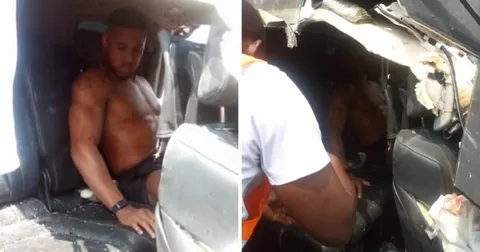
On 29 December 2025, an accident on a major highway in Ogun State abruptly transformed a routine festive season visit into a moment of irreversible loss when a vehicle carrying world-renowned boxer Anthony Joshua was involved in a collision that resulted in the death of two of his closest professional companions.
While he himself survived with injuries that required medical attention but were not life-threatening, and while early reporting focused heavily on the shock value of a global sports figure being caught in tragedy, the deeper meaning of the incident lies not in celebrity but in context, structure, and consequence, because stripped of fame and headlines, the crash followed a pattern that is painfully familiar on Nigerian roads, one where speed, road design, enforcement gaps, and roadside hazards intersect with devastating regularity, yet only briefly command national attention when a recognisable name is attached to the outcome.
According to initial accounts from authorities and witnesses, the vehicle was travelling along the Lagos Ibadan Expressway, a corridor long associated with high traffic volume and fatal accidents, when it collided with a stationary truck parked along the roadside, an occurrence that on its own already raises uncomfortable questions about road regulation, visibility, warning systems and compliance with safety rules, especially on highways where long stretches encourage high speed and risk taking, and while investigations pointed to unsafe overtaking and speed as contributing factors, these explanations, though valid, barely scratch the surface of a system where such behaviour has become normalised rather than exceptional.
The two men who lost their lives were not anonymous passengers but key figures in Anthony Joshua’s professional life, individuals whose daily work revolved around preparing an elite athlete for the physical and mental demands of boxing at the highest level, and their deaths represent not only a personal tragedy for their families and colleagues but also the sudden erasure of years of expertise, mentorship and shared professional history, a dimension often lost when coverage compresses human lives into a sentence or two beneath a headline dominated by survival statistics.
Anthony Joshua himself was hospitalised following the crash, treated for injuries and placed under observation, and while public statements confirmed his stable condition and conveyed condolences, his relative silence afterwards has been notable, not as an absence of feeling but as an indication of the gravity of the moment, because for someone whose career has been built around controlled violence within the ring, facing mortality outside that environment, without warning or preparation, introduces a different kind of reckoning that cannot be resolved through physical recovery alone.
The timing of the accident, occurring during a period traditionally associated with celebration and homecoming, further deepened its emotional impact, particularly given Joshua’s long-acknowledged ties to Nigeria and the symbolic weight of his presence in the country, a reminder that national pride and personal vulnerability often coexist uncomfortably in the lives of public figures.
Beyond the individuals directly involved, the crash once again exposed the persistent crisis of road safety in Nigeria, where highways designed to support commerce and connectivity have also become sites of frequent loss, and where enforcement mechanisms often struggle to match the realities of traffic volume, driver behaviour and infrastructural wear, creating an environment in which accidents are not anomalies but recurring outcomes, and the Lagos Ibadan Expressway, despite its strategic importance, continues to illustrate how inadequate monitoring of parked heavy vehicles, insufficient warning signage and inconsistent speed regulation combine to create lethal conditions, especially during peak travel periods.
What distinguishes this incident from countless others is not the mechanics of the crash but the attention it generated, because when ordinary commuters are involved, similar tragedies rarely spark sustained discussion or policy urgency, yet when an internationally recognised athlete is affected, the same structural issues briefly move into public view, raising the uncomfortable question of why visibility, rather than severity or frequency, often determines response.
Media handling of the story further complicates the narrative, as the initial hours following the accident saw rapid circulation of videos and fragments of information, some accurate, others speculative, reflecting a broader media environment where immediacy often outruns verification, and where the emotional pull of celebrity can overshadow the quieter but more important task of explanation, resulting in coverage that tells audiences what happened without adequately exploring why it keeps happening.
From a broader analytical perspective, the crash also invites scrutiny of how professional sports teams manage travel and risk, particularly in regions where infrastructure challenges are well documented, because while elite athletes benefit from advanced training, medical care and security, these advantages can create a false sense of insulation from everyday dangers, an assumption exposed as flawed when accidents occur outside controlled environments, and this incident may well prompt reconsideration within sports management circles about route planning, escort arrangements and engagement with local safety authorities, not as a matter of privilege but of responsibility.
For Nigeria, the international attention surrounding the crash briefly reframed long-standing concerns about transport safety within a global conversation, highlighting how local infrastructural shortcomings can have reputational as well as human costs, and while public sympathy understandably centred on Anthony Joshua and the families of the deceased, the broader lesson remains that road safety failures do not discriminate by status, affecting athletes, traders, families and drivers alike, often with the same tragic outcomes.
The human cost of the accident extends beyond immediate fatalities and injuries, encompassing psychological trauma, disrupted livelihoods and long-term grief, dimensions that rarely fit neatly into news cycles but define the lived reality of those left behind, and for the families of the two men who died, the crash represents not a moment but a permanent rupture, one that no amount of public attention can truly address.
In examining this event through an analytical lens rather than a sensational one, it becomes clear that the Anthony Joshua crash is best understood not as an isolated misfortune but as a case study in how systemic risks manifest when opportunity, speed and inadequate safeguards converge, and how society often reacts more strongly to who is involved than to what the incident reveals about shared vulnerability.
If the story is allowed to fade once the immediate news value diminishes, it will join a long list of tragedies that briefly shocked and then disappeared without consequence, but if it is treated as a moment for sustained reflection and action, it could contribute, however modestly, to renewed pressure for enforcement, infrastructure review and public education around road use.
Ultimately, what makes this incident significant is not the survival of a famous boxer or the virality of accident footage, but the reminder that progress in any society is measured not only by its global icons but by how it protects lives in ordinary, everyday spaces, and until Nigerian roads are treated as critical public safety systems rather than unavoidable hazards, similar stories will continue to emerge, with or without famous names attached, leaving behind grief, questions and a familiar sense that the warning signs were always there.