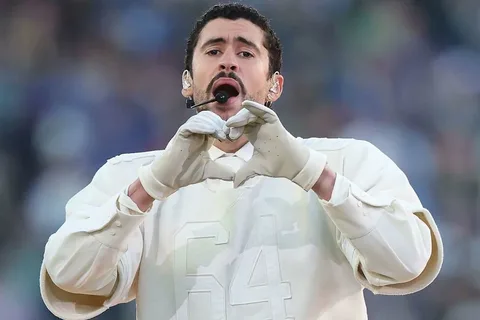
For the first time in Super Bowl history, the Super Bowl LX halftime show on 8 February 2026 featured a performance almost entirely in Spanish, headlined by Puerto Rican artist Bad Bunny. The event at Levi’s Stadium in Santa Clara, California, where the Seattle Seahawks and New England Patriots competed, became not only a musical highlight but also a cultural flashpoint, drawing wide public attention, divided reactions and unexpected fallout well beyond the football field. The performance included prominent surprise appearances by Lady Gaga and Ricky Martin, and was followed by intense political reactions and a dramatic change to Bad Bunny’s social media presence.
Bad Bunny, whose real name is Benito Antonio Martínez Ocasio, made history as the first Latino solo artist to headline the Super Bowl halftime show. The Apple Music-sponsored set was nearly entirely in Spanish, a choice that underscored his cultural identity and artistic style, and was widely interpreted as a celebration of Latin music and heritage on one of the world’s biggest entertainment platforms. His setlist included a mixture of high-energy songs that spotlighted Latino music genres and showcased his career achievements.
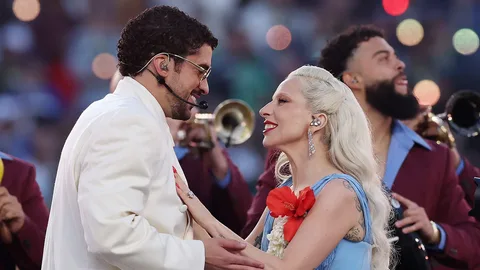
The performance was rich in theatrical elements, including staged scenes designed to evoke Puerto Rican community imagery and traditional settings. It also featured appearances by renowned artists and celebrities. Lady Gaga joined Bad Bunny on stage for a surprise salsa-inspired rendition of her song “Die With a Smile”, while Ricky Martin performed his own interpretation of “Lo Que Le Pasó a Hawai’i”, a track associated with Bad Bunny’s award-winning catalogue. Other celebrities, including Cardi B, actor Pedro Pascal and Jessica Alba, made cameo appearances in various segments of the show, adding to the spectacle.
The show concluded with a distinct message of unity. Bad Bunny carried a football emblazoned with the words “Together, We Are America”, and the stadium screen displayed the phrase “The only thing more powerful than hate is love” as performers held flags from across the Americas. This closing moment was widely interpreted as a symbolic statement, emphasising not only cultural inclusion but also a broader message of shared identity across nations.
Cultural Reach And Audience Response
Bad Bunny’s appearance as the halftime headliner drew massive viewership. Early estimates suggest that the audience for the halftime segment reached or even exceeded more than 120 million viewers globally, reflecting both the popularity of the Super Bowl and Bad Bunny’s status as one of the most streamed artists in recent years.
Public reaction was mixed but intense. Fans praised the cultural representation and artistic boldness of the show, embracing it as a historic celebration of Latino music and identity. Supporters pointed to Bad Bunny’s ability to bring depth and diversity to a platform that has traditionally catered to mainstream English-language pop, citing his Grammy recognition and global influence as key context.
Political And Public Criticism
However, not all responses were positive. Former United States President Donald Trump was among the most vocal critics. Writing on his social media platform after the show, Trump described the performance as “absolutely terrible, one of the worst, ever,” saying it was “an affront to the Greatness of America” and claiming that “nobody understands a word this guy is saying.” He also criticised the dancing, calling it “disgusting, especially for young children that are watching.” Trump’s remarks reflected a broader pattern of conservative criticism aimed at the decision to feature a largely Spanish-language set and at Latino cultural expression on such a high-profile American stage.
Trump’s criticism extended beyond the performance itself. He framed his comments in the context of what he described as broader cultural standards in America, and predicted that media reviews would praise the show despite his objections. His statements also referenced other topics, including the NFL’s policies, though they remained focused primarily on his disapproval of the halftime content.
The political reaction was not limited to Trump. Influencer and boxer Jake Paul also drew attention by calling Bad Bunny a “fake American citizen,” an assertion that was widely challenged and clarified given that Puerto Ricans are U.S. citizens by birth. Paul later walked back some of his remarks after pushback from his brother Logan Paul, who defended the nationality status of Puerto Ricans and emphasised that Bad Bunny’s heritage and citizenship are part of the American fabric.
Democratic figures responded differently. California Governor Gavin Newsom publicly praised Bad Bunny’s performance as a beautiful moment and emphasised its expressive celebration of diverse cultures. Such praise contrasted sharply with the critiques from conservative commentators and political figures, illustrating how the halftime show quickly became a broader culture-war talking point.
Instagram Deletion And Speculation
In the hours after the Super Bowl performance concluded, Bad Bunny made an unexpected change to his Instagram profile that generated its own wave of reaction and speculation. Shortly after the event, the artist removed all posts from his account, deleted his profile picture, and unfollowed every other account, leaving only a single link in his bio to his latest album. His follower count, which remained in the tens of millions, was still visible but devoid of content.
This complete deletion of posts and reset of his Instagram footprint was interpreted in multiple ways. Some fans speculated that the move could be a deliberate artistic reset or a lead-in to a new era in his career, a common strategy among artists ahead of new releases or significant announcements. Social media commentators noted that Bad Bunny had previously cleared his Instagram during past career cycles, adding weight to the theory that this was a planned transition rather than a direct response to criticism.
Others linked the Instagram deletion to the intense backlash from certain political voices and online commentators, suggesting that the stark visual silence on his social media could be a reaction to the firestorm of debate that followed the halftime show. At the time of reporting, neither Bad Bunny nor his representatives had provided an official explanation for the deletion.
Broader Cultural Impact
The Super Bowl 2026 halftime show stands out not only for its musical presentation but also for the discussions it has generated about cultural representation, language, identity and audience expectations on global stages. Bad Bunny’s decision to foreground the Spanish language, Latino heritage and an inclusive message resonated deeply with many viewers, while striking a nerve with those who advocated for more traditional or mainstream cultural norms.
Analysts note that the controversy reflects broader cultural tensions in the United States, where entertainment, politics and identity politics often intersect. In this context, the performance did more than entertain; it sparked debate about what it means to be American, how diverse voices are represented in major cultural moments, and how audiences respond to shifts from established tradition.
The Super Bowl LX halftime show featuring Bad Bunny, Lady Gaga and Ricky Martin will be remembered as one of the most discussed and consequential performances in the event’s history. Combining cultural celebration, star power and political reaction, it extended far beyond a musical performance and became a flashpoint for conversation on unity, language and representation. As reactions continue to evolve in the wake of the show and Bad Bunny’s dramatic social media reset, the legacy of this halftime set is likely to be examined in both entertainment and cultural discourse for months to come.