
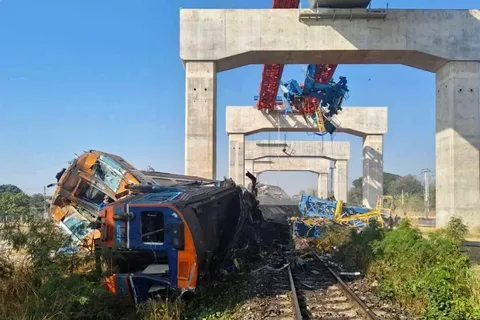
At least 32 people have been killed after a large construction crane collapsed onto a passenger train in Thailand, triggering one of the country’s deadliest infrastructure-related disasters in recent years. The incident occurred during daytime operations on an active rail line, sending shockwaves through the transport system and prompting a nationwide review of construction safety near public transit corridors.
Thai authorities confirmed that the crane, which was part of an ongoing construction project near the railway, fell directly onto several carriages of a moving train. Emergency responders were dispatched within minutes, but the scale of the impact resulted in significant casualties, with dozens more injured and transported to nearby hospitals.
Initial reports indicate that the train was carrying commuters and long-distance passengers at the time of the collapse. Several carriages were severely damaged, and rail services along the affected route were immediately suspended as rescue operations and investigations began.
The collapse occurred near a densely populated area where construction work had been underway for several months. Witnesses described hearing a loud structural failure before the crane fell across the tracks, leaving little time for the train to slow or stop before impact.
Rescue teams, including police, firefighters, military units, and medical personnel, worked for hours to extract survivors from the wreckage. Heavy machinery was deployed to stabilise the site and remove debris, while search teams continued to account for missing passengers.
Thai transport officials confirmed that at least 32 fatalities had been recorded, a figure that may rise as investigations continue and critically injured victims remain under medical care. Hospitals in the region activated emergency protocols to manage the influx of casualties, while blood donation centres issued urgent appeals.
The government has described the incident as a national tragedy and expressed condolences to the families of the victims. Senior officials travelled to the site shortly after the collapse to oversee emergency response efforts and assess the situation firsthand.
Authorities have launched a formal investigation to determine the cause of the crane failure. Early lines of inquiry include whether the crane was properly installed, whether safety inspections were conducted as required, and whether construction protocols near active railway lines were adequately enforced.
Engineering experts have been tasked with examining the crane’s structure, load limits, and anchoring system. Investigators are also reviewing weather conditions, maintenance records, and the qualifications of the construction crew involved in the project.
While no official conclusion has been reached, concerns have already been raised about oversight and coordination between construction firms and transport authorities. Questions are being asked about how heavy construction equipment was permitted to operate so close to an active rail line without additional protective measures.
Railway officials confirmed that train services on the affected route will remain suspended until safety inspections are completed and repairs are carried out. Alternative transport arrangements have been put in place for passengers, though significant disruption is expected to continue in the coming days.
The train operator stated that the driver followed standard operating procedures and had no warning of the impending collapse. Data from the train’s onboard systems is being reviewed to establish the train’s speed and response time at the moment of impact.
Passengers who survived the incident described scenes of confusion and panic as the crane struck the train. Many reported sudden jolts, shattered windows, and a loss of power as carriages came to an abrupt stop. Emergency exits were used to evacuate passengers where possible, while others required assistance from rescue teams.
The incident has renewed scrutiny of construction safety standards in Thailand, particularly in urban areas where large-scale infrastructure projects are frequently carried out alongside existing transport networks. Over the past decade, the country has invested heavily in rail expansion, urban development, and public works, increasing the complexity of managing construction risks.
Safety advocates have long warned that enforcement of construction regulations can be inconsistent, especially when multiple contractors and government agencies are involved. The crane collapse has intensified calls for stricter monitoring, clearer accountability, and harsher penalties for violations.
Political leaders from across the spectrum have called for a transparent investigation and accountability if negligence is found. Some lawmakers have urged the government to temporarily halt similar construction projects pending safety reviews, arguing that public confidence in infrastructure safety has been severely shaken.
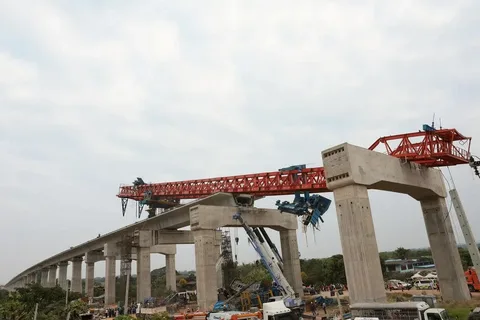
The Ministry of Transport has announced the formation of a special inquiry committee comprising engineers, safety regulators, and independent experts. The committee has been instructed to deliver preliminary findings within weeks and to recommend immediate measures to prevent similar incidents.
The construction company responsible for the crane has issued a brief statement expressing regret over the incident and pledging full cooperation with authorities. The company has not commented on potential liability or compensation, stating that it will await the outcome of the investigation.
Under Thai law, companies found responsible for fatal industrial accidents may face criminal charges, fines, and civil lawsuits. Previous cases have resulted in both corporate penalties and individual prosecutions of site managers and engineers.
For families of the victims, the focus has shifted to identification, funeral arrangements, and seeking answers. Government officials have promised financial assistance to affected families, including compensation payments and support for medical expenses of the injured.
Human rights and labour organisations have emphasised the need to ensure that victims’ families are not left to navigate complex legal processes alone. They have called for prompt compensation and long-term support, particularly for families who lost primary income earners.
The disaster has also raised broader questions about risk management in rapidly developing countries, where infrastructure expansion often outpaces regulatory capacity. Experts note that cranes are among the most dangerous pieces of construction equipment if not properly installed and monitored, especially near public spaces.
International safety standards typically require buffer zones, reinforced barriers, and real-time monitoring when heavy machinery operates near railways or roads. Investigators will examine whether such measures were in place and whether they were enforced consistently.
As night fell on the day of the collapse, emergency lights illuminated the wreckage while recovery efforts continued. Authorities confirmed that all passengers had been accounted for, but structural assessments of the site were still underway to ensure there was no further risk of collapse.
In the days ahead, attention will turn to the findings of the investigation and the actions taken by the government and industry in response. Public confidence in rail safety, a cornerstone of daily life for millions of commuters, has been deeply affected.
For now, Thailand mourns the loss of at least 32 lives in an incident that has exposed vulnerabilities in construction oversight and infrastructure safety. The outcome of the investigation will be closely watched, not only by the families of the victims but by a public demanding assurance that such a tragedy will not be repeated.