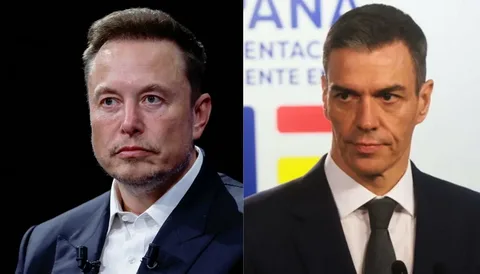
Elon Musk has publicly criticised Spanish Prime Minister Pedro Sánchez, calling him a “tyrant” over proposed measures to restrict access to social media for children under the age of 16 and to strengthen regulation of online hate content. The remarks have added an international dimension to a domestic policy debate in Spain and have once again placed Musk at the centre of global discussions on free speech, digital regulation, and the power of governments over online platforms.
The comments were made on Musk’s social media platform X, where he has frequently challenged governments and regulators over content moderation policies. Musk’s criticism came as Spain moves forward with proposals aimed at increasing protections for minors online and curbing the spread of harmful and hateful material on digital platforms.
The Spanish government has not directly responded to Musk’s remarks, but officials have previously defended the proposals as necessary measures to protect children and uphold democratic standards in online spaces.
Spain’s Proposed Social Media Restrictions
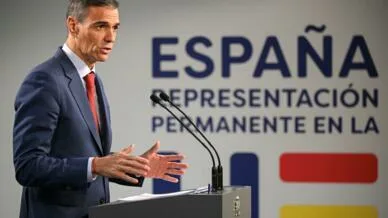
The Spanish government’s plan includes proposals to limit access to social media platforms for users under the age of 16. The measures are part of a broader digital safety strategy focused on child protection, mental health, and the reduction of harmful online behaviour.
Under the proposals, social media companies would be required to implement stronger age verification systems to prevent underage users from creating accounts. The government has also indicated that platforms could face penalties if they fail to comply with age restrictions or do not take sufficient action to limit the exposure of minors to harmful content.
In addition to age limits, the proposals include tighter oversight of online content considered hateful, abusive, or harmful. This includes content that promotes violence, discrimination, or harassment based on characteristics such as race, gender, religion, or sexual orientation.
Spanish officials have argued that existing self-regulation by platforms has been insufficient and that state intervention is necessary to ensure public safety and protect vulnerable groups.
The Government’s Rationale
The Sánchez administration has framed the proposals as a response to growing evidence linking excessive social media use among children to mental health issues, including anxiety, depression, and exposure to online abuse. Officials have also cited concerns over cyberbullying, radicalisation, and the spread of disinformation.
Spain is not acting in isolation. Several European countries have introduced or are considering similar measures, and the European Union has already adopted legislation aimed at increasing platform accountability, particularly with regard to illegal and harmful content.
The Spanish government has emphasised that the proposals do not amount to censorship but rather represent regulation designed to align digital platforms with existing legal and social standards that apply offline.
Elon Musk’s Response
Elon Musk has consistently positioned himself as a defender of free expression, particularly since acquiring X. He has criticised what he describes as overreach by governments seeking to control online speech and has opposed mandatory content moderation rules imposed by states.
In his response to Spain’s proposals, Musk described the prime minister as a “tyrant”, arguing that restricting access to social media and increasing content regulation undermines individual freedoms. His comments were brief but highly visible, given his global following and the influence of his platform.
Musk has previously clashed with governments in Europe over digital regulation, including rules related to content moderation, transparency, and platform accountability. His criticism of Spain follows a pattern of public confrontations with political leaders over technology policy.
Free Speech Versus Regulation
At the core of the dispute is a long-running debate over where the line should be drawn between protecting users and preserving freedom of expression. Supporters of Spain’s proposals argue that children require special protections and that unregulated platforms have failed to adequately address harm.
Critics, including Musk, argue that such measures risk setting precedents that allow governments to exert excessive control over digital spaces. They contend that age bans and content restrictions can be difficult to enforce without infringing on privacy and free speech.
The tension between these positions reflects a broader global struggle to define the responsibilities of technology companies and the limits of state authority in the digital age.
Legal And Regulatory Context In Europe
Spain’s proposals sit within a wider European regulatory framework that has increasingly focused on platform responsibility. EU legislation has introduced obligations for major online platforms to assess and mitigate risks related to illegal content, disinformation, and harm to minors.
European regulators have argued that voluntary measures by companies have not delivered consistent results and that binding rules are necessary. Enforcement powers include fines and, in extreme cases, restrictions on services.
Spain’s initiative goes further by explicitly targeting age access to social media, a step that has sparked debate even within Europe about feasibility and proportionality.
Age Verification And Enforcement Challenges
One of the most contentious aspects of the proposals is how age restrictions would be enforced. Reliable age verification remains a technical and ethical challenge, raising concerns about data privacy and the collection of personal information.
Critics argue that stricter age checks could lead to increased data harvesting or exclusion of legitimate users. Supporters counter that technological solutions exist and that safeguards can be built to minimise privacy risks.
The Spanish government has indicated that it would work with regulators and industry experts to develop systems that balance safety and privacy, though details have not yet been finalised.
Political Reactions Within Spain
Domestically, the proposals have received mixed reactions. Child protection advocates and some educators have welcomed the plans, arguing that they reflect a necessary update to laws written before the rise of social media.
Opposition parties have raised concerns about government overreach and questioned whether enforcement would be effective. Some critics have accused the government of using child safety as a justification for broader speech controls.
Despite the debate, public concern over children’s online safety remains high, and opinion polls in Spain have shown significant support for stronger regulation of social media platforms.
Musk’s Broader Influence On The Debate
Elon Musk’s intervention has amplified the issue beyond Spain, drawing international attention to the proposals. As the owner of a major global platform, his views carry weight, particularly among free speech advocates and technology investors.
However, Musk’s critics argue that his position reflects the commercial interests of platform owners who benefit from minimal regulation. They point out that content moderation decisions are already made by private companies, often without transparency or accountability.
Musk has repeatedly argued that open debate, rather than regulation, is the best way to address harmful content, though this approach has faced criticism from regulators and civil society groups.
Implications For Social Media Platforms
If Spain proceeds with the proposals, social media companies may need to adapt their services for the Spanish market, including implementing stricter age controls and content monitoring systems. This could increase operational costs and raise questions about consistency across jurisdictions.
Platforms operating across Europe already face a complex regulatory landscape, and national measures add further layers of compliance. Some companies may push back through legal challenges or seek exemptions.
The outcome in Spain could influence similar debates in other countries, particularly if the measures prove effective or face significant legal obstacles.
What Happens Next
The Spanish government is expected to continue consultations and legislative processes before finalising the proposals. Any new law would likely face scrutiny from courts, regulators, and industry stakeholders.
Elon Musk’s comments are unlikely to alter the legislative process directly, but they highlight the global stakes involved in national decisions about digital regulation. The clash underscores how technology policy has become a focal point for broader ideological battles over freedom, safety, and state power.
As governments across Europe and beyond grapple with the impact of social media on society, the debate sparked by Spain’s proposals and Musk’s response is likely to continue. The balance between protecting minors, curbing harmful content, and preserving free expression remains one of the most contested issues in modern policymaking.