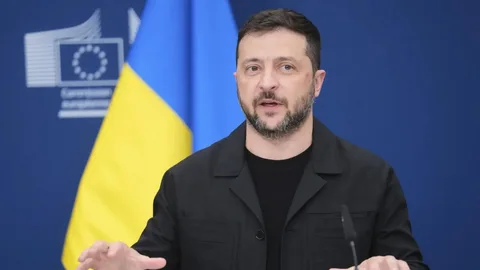
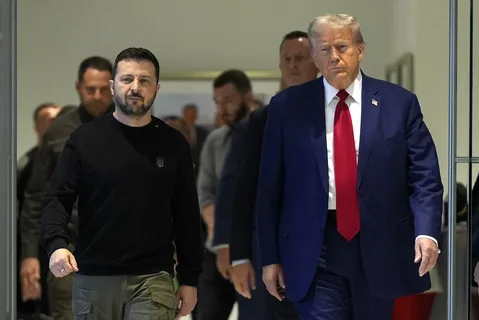
Ukrainian President Volodymyr Zelenskyy has declared that he is ready for national elections, a statement that follows renewed scrutiny from United States President Donald Trump, who publicly questioned the strength of Ukraine’s democratic processes during wartime. The Ukrainian leader’s remarks, delivered during a press engagement on his ongoing diplomatic tour across Europe, represent a notable shift from Kyiv’s longstanding position that wartime conditions and martial law legally prevent nationwide elections from taking place.
Trump, speaking in a recent interview, argued that Ukraine could no longer claim to be a fully functioning democracy if it continued to delay elections. According to him, Kyiv appeared to be using the conflict with Russia as a justification to extend Zelenskyy’s tenure indefinitely. Trump suggested that Ukraine should “start accepting things” and proceed with elections despite the realities of ongoing conflict. His comments immediately stirred reactions across the international community and ignited a renewed debate in Kyiv about whether conditions on the ground permit any credible political contest.
Ukraine’s constitution explicitly restricts presidential elections during periods of martial law, and this clause has served as the legal basis for postponing the vote that would have taken place in 2024. Zelenskyy’s five-year term officially ended in May 2024, but his continuation in office has been justified by emergency wartime provisions. Many Ukrainian lawmakers have repeatedly defended this stance, arguing that elections conducted during active conflict would undermine national security, place millions of lives at risk, and create new opportunities for Russian interference.
The security challenges remain significant. Ukraine continues to face near-daily missile strikes, cross-border attacks and targeted bombardments of civilian and military infrastructure. Several regions remain under Russian occupation, and millions of citizens are displaced internally or living abroad. An election under these circumstances would need special mechanisms to ensure safety, transparency and fairness. Questions persist about how displaced citizens would vote, how occupied territories would be represented and how political campaigns could be conducted without diverting military resources.
Despite these challenges, Zelenskyy stated that he is personally ready for elections and that Ukraine could move ahead within 60 to 90 days if key allies provide the necessary security backing. He clarified that his readiness is not the sole deciding factor and that the matter ultimately depends on both the Ukrainian parliament and the international community that supports Kyiv’s defence capabilities.
Zelenskyy’s response to Trump appeared carefully calibrated. While firm in asserting Ukraine’s sovereignty in determining its internal affairs, he did not dismiss the possibility of elections. Instead, he emphasised that Ukraine would be willing to proceed if its allies helped create conditions that guarantee safety for both voters and election workers. He called on lawmakers to begin preparing legislative changes that would make elections possible during martial law and urged international partners to assist in securing polling stations and logistics.
His remarks underscored a broader diplomatic strategy. By signalling openness to elections, Zelenskyy positions himself as responsive to concerns raised by one of Ukraine’s most important allies. At the same time, he highlights the heavy reliance Ukraine has on Western support, not only for its war effort but also for enabling democratic processes amid conflict. In essence, Zelenskyy is telling the world that Ukraine is not opposed to elections in principle, but that conducting them requires a level of security that Ukraine cannot independently guarantee.
This stance places part of the responsibility on the United States and Europe. If Kyiv moves forward with elections, it will only be because its partners provided enough support to make them feasible. If elections remain impossible, Zelenskyy can point to security deficiencies rather than political reluctance.
Zelenskyy’s announcement has generated mixed reactions within Ukraine. While some citizens and political groups welcome the possibility of elections as a reaffirmation of democratic values, others warn that it is deeply impractical and potentially dangerous. Military leaders have expressed concerns that elections could disrupt operational focus and provide openings for Russian propaganda and psychological warfare. War fatigue among the population is another factor, with many questioning whether a contentious political season would weaken national unity.
Opposition figures, while critical of Zelenskyy on various fronts, also acknowledge the extraordinary circumstances the country faces. Some argue that holding elections now would unfairly benefit the incumbent, who commands wartime visibility and influence. Others feel that delaying elections indefinitely risks damaging Ukraine’s international image and undermines its case for continued Western support. The balancing act is delicate, and any decision will have both political and strategic consequences.
For Zelenskyy, agreeing to elections can serve several purposes. It offers a rebuttal to Trump’s criticism, reassures allies of Kyiv’s democratic commitments and strengthens Ukraine’s diplomatic stance at a time when pressure is mounting for a negotiated settlement. With discussions about potential peace terms intensifying internationally, signalling readiness for elections helps Zelenskyy reaffirm that Ukraine remains committed to democratic norms even under existential threat.
President Trump’s remarks have added a new layer of complexity to United States-Ukraine relations. While some American officials support the push for democratic accountability, others warn that insisting on elections during an active war oversimplifies Ukraine’s realities. The comments also reflect broader shifts in Washington’s foreign policy priorities, with the Trump administration exploring alternative approaches to the conflict, including the possibility of negotiations that could involve territorial compromises.
Trump’s scepticism regarding sustained military assistance has already prompted concerns in Kyiv about the future of U.S. support. By calling for elections, the U.S. President appears to be framing democratic reform as a condition for continued partnership. This pressure places Ukraine in a challenging position, forcing Kyiv to balance wartime security considerations with diplomatic expectations from its most influential ally.
European leaders have continued expressing strong support for Ukraine’s sovereignty and democratic resilience. In response to Trump’s statements, several European foreign ministries reiterated that elections should not be forced under unsafe conditions and that the primary focus remains Ukraine’s right to defend itself. However, Zelenskyy’s new openness to elections will likely prompt further discussion within European institutions about how they can assist in creating a safer environment for such a process.
For Ukraine, the prospect of elections during wartime is not merely a legal question but a geopolitical one. The decision will send a strong message about the nation’s resilience and commitment to democratic norms. However, the risks are undeniable. Conducting elections under fire could expose civilians to harm, strain Ukraine’s already burdened infrastructure and provide opportunities for Russian interference aimed at delegitimising the results.