
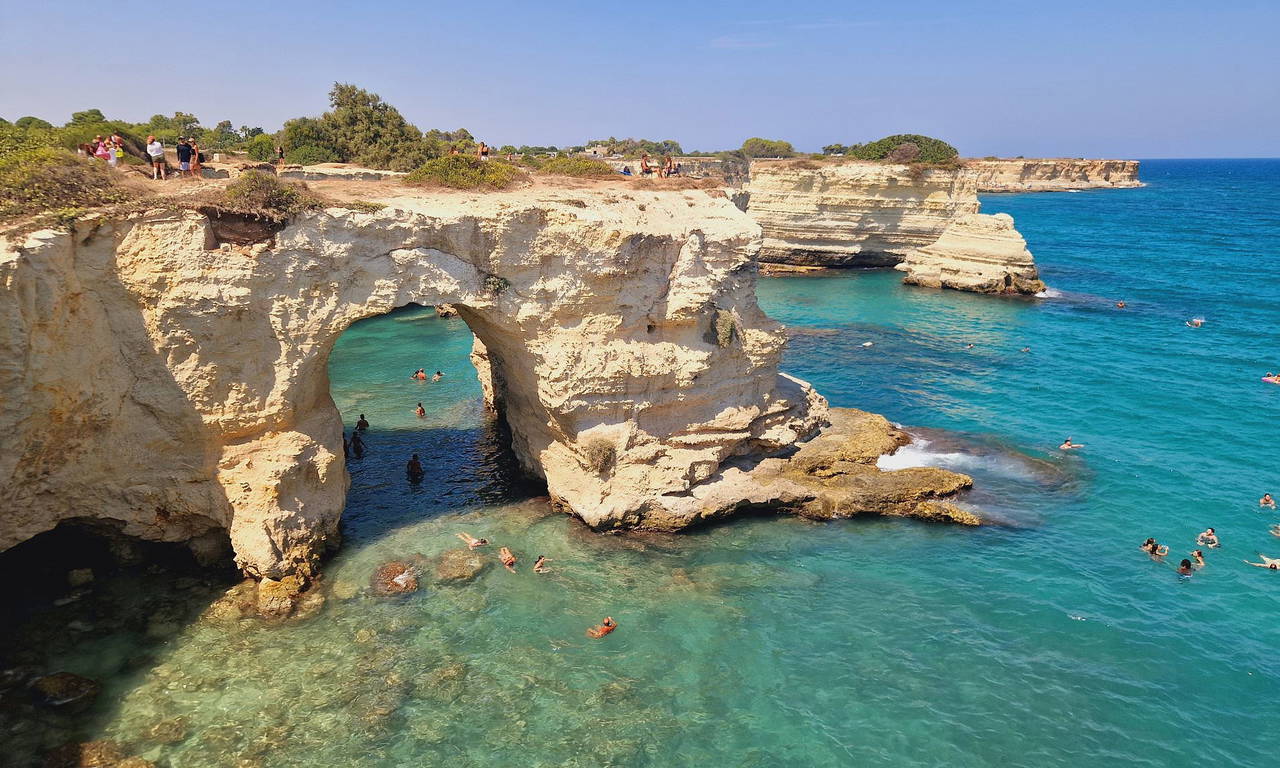
Italy’s iconic natural landmark known as the Lovers’ Arch collapsed into the Adriatic Sea on Valentine’s Day, a dramatic event that has saddened residents, alarmed tourism authorities and underscored the effects of severe weather and coastal erosion on cherished natural formations.
The arched rock, a prominent feature of the Faraglioni di Sant’Andrea sea stacks near Melendugno in the southern region of Puglia, fell into the water after enduring days of heavy rain, strong winds and rough seas. The loss was first discovered on the morning of 15 February 2026 when visitors noticed the formation was missing and reduced to rubble on the shoreline.
The Lovers’ Arch, locally known in Italian as Arco degli Innamorati, had long been one of southern Italy’s most recognisable coastal features and a magnet for couples, photographers and tourists from around the world. Situated off the sandy beaches and limestone cliffs of the Salento peninsula, it was often featured on travel postcards and holiday guides to the region. Its collapse has been described by local officials as both a symbolic and economic loss, especially given its location in one of Italy’s most popular tourist destinations.
The mayor of Melendugno, Maurizio Cisternino, called the collapse what he termed “a very hard blow” for the community and its tourism industry. He said the event was “an unwanted Valentine’s Day gift” and pointed to the relentless battering of the coastline by recent storms as the cause of the arch’s demise. “Nature has taken back what it created,” he said, summarising the understanding that extreme weather accelerated an eventual collapse that officials and locals had long feared.
Authorities reported that Storm Oriana, which swept across southern Italy in the days leading up to the collapse, brought gale-force winds, torrential rain and powerful surges that weakened the already fragile limestone structure. They said the arch had been eroding over time as part of natural geological processes, but the intensity of the weather over the Valentine’s weekend was sufficient to bring it down sooner than many expected. Local civil protection officials, geologists and tourism representatives have highlighted that other sections of the limestone coast show visible cracks and may be at similar risk, prompting concern for future landscape changes.
The arch’s significance was not merely scenic. Local legend enveloped the formation in romantic lore. According to stories passed down through generations, couples who kissed beneath the arch were said to enjoy everlasting love, and some traditions even held that swimming together through its span would bind partners forever. Whether grounded in fact or folklore, such tales drew thousands of visitors to the Salento coast each year, particularly around Valentine’s Day and the summer months. Many engaged in wedding proposals, engagement photography and romantic excursions at the site.
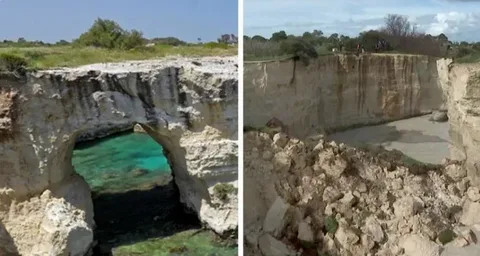
The historical origins of the arch predate its romantic association. Geologists and historians note that the structure was formed over centuries by wind, wave action and the dissolving forces of the sea against softer limestone, creating the elegant bridge that framed the turquoise water of the Adriatic. In earlier centuries, the cliffs and stacks of Torre Sant’Andrea served as lookout points and strategic vantage places for coastal watchers guarding against pirate incursions along Italy’s southern shorelines. Over time, however, nature’s slow sculpting gave way to modern tourism’s embrace of its scenic value.
Puglia’s regional president, Antonio Decaro, commented on the loss, saying authorities had to focus on measures to slow coastal erosion and protect vulnerable areas along the Salento shoreline. He described the arch as “one of our region’s defining characteristics, a symbolic asset” and warned that similar formations could deteriorate without effective intervention. The collapse has renewed debate among scientists, environmentalists and policymakers about how best to respond to changing weather patterns, rising sea levels and the long-term impacts of climate change on Italy’s coastal ecosystems.
The immediate economic impact of the collapse is expected to be felt through reduced tourist activity in the area. Local business owners, hotel operators and tour guides who depended on the iconic landmark for marketing and visitor appeal have expressed concern. Although the region still boasts other beaches, cliffs, caves and historic towns, the sudden absence of the arch represents a loss of a distinctive image that helped define the identity of Salento for many travellers.
While the arch itself has vanished, the underlying issues that led to its collapse remain a focus of attention. Coastal erosion along the Adriatic coast, particularly in Puglia, has been a concern for decades, with scientists noting that rising sea temperatures, more frequent and severe storms and human activity can accelerate the breakdown of fragile limestone features. Initiatives to study erosion patterns, reinforce vulnerable sections of coastline and educate communities about environmental changes have gained urgency following the event.
In response to the collapse, some local tourism boards have begun promoting alternative attractions in Salento, such as the nearby caves of Porto Badisco, the Adriatic views from historic Otranto and Santa Maria di Leuca lighthouse treks. These efforts aim to maintain visitor interest while longer-term plans for environmental protection and conservation are developed. Officials acknowledged that reconstruction of the arch itself is neither feasible nor advisable, given the natural forces that shaped and ultimately destroyed it.
The demolition of the Lovers’ Arch follows a series of extreme weather events that have battered southern Italy in recent months, contributing to widespread damage across regions beyond Puglia. In parts of Sicily, powerful storms and landslides have forced evacuations and damaged property, highlighting the region’s vulnerability to climatic extremes. The arch’s dramatic collapse has become emblematic of these challenges, illustrating how even long-standing natural wonders can be altered or lost by acute weather conditions.
Local officials, environmental scientists and community advocates alike have urged that the arch’s disappearance be recognised not only as a loss for tourists and romantics, but as a reminder of the broader environmental pressures facing Italy’s coastlines. Future strategies to monitor and mitigate erosion, safeguard coastal landmarks, and adapt to evolving weather patterns are now subjects of policy discussion at both regional and national levels.
The collapse of Italy’s Lovers’ Arch on Valentine’s Day 2026 stands as a stark illustration of the intersection between natural beauty, cultural symbolism and the growing impacts of climate-related weather extremes. Though the arch now rests as rubble in the sea it once framed so elegantly, its legacy as a romantic icon endures in countless photographs, memories and stories from those who visited this beloved feature of the Mediterranean coast.