
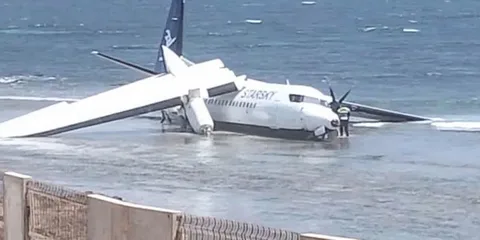
A passenger aircraft carrying 55 people crash-landed on a beach in Mogadishu, Somalia, on Tuesday following a technical problem shortly after take-off, Somali aviation authorities said. All 50 passengers and five crew members on board were safely evacuated, and no serious injuries or fatalities were reported. The incident has prompted an investigation into the technical fault and raised questions about aircraft safety procedures for regional carriers.
The flight, operated by Starsky Aviation and using a Fokker 50 turboprop aircraft with registration 6O-YAS, departed from Aden Abdulle International Airport in Mogadishu bound for the northern city of Gaalkacyo when it developed a technical malfunction approximately 15 minutes after take-off.
According to Somalia’s Civil Aviation Authority (CAA), the crew notified air traffic control of the technical problem and requested permission to return to the airport. The aircraft made an emergency landing back at the airport, but during the landing it overran the runway and continued across adjacent terrain before coming to rest on shallow water at the shoreline next to a beach on the Indian Ocean.

Sequence Of Events
After reporting the technical issue, the flight crew initiated a return to Aden Abdulle International Airport under emergency procedures. The aircraft touched down on the runway, but was unable to decelerate sufficiently before the end of the runway. It overran the tarmac, continued down an embankment, and finally settled in shallow water on a beach area just outside the airport perimeter.
Emergency responders, including teams from the African Union Support and Stabilisation Mission in Somalia (AUSSOM) and United Nations troops, were quickly deployed to assist with evacuation and rescue operations. Somalia’s Transport Minister Mohamed Farah Nuh visited the site and confirmed that all 55 occupants were accounted for and in good condition.
Footage shared on social media from the scene showed passengers walking away from the wreckage on the shoreline under their own power, with no reports of serious injuries.
Aircraft, Airline And Crew
The aircraft involved was a Fokker 50, a twin-turboprop regional airliner commonly used on short domestic and regional routes. Starsky Aviation, the airline operating the flight, has its base in Mogadishu and operates domestic services within Somalia. The airline praised the flight crew for their handling of the emergency, particularly the pilot’s swift and calm decision-making, which officials said was crucial in ensuring the safety of everyone on board.
Starsky Aviation’s chief executive, Ahmed Nur, said that no fatalities or serious injuries occurred and that passengers and crew were evacuated promptly after the plane came to rest. He emphasised that only the aircraft suffered substantial damage.
Passenger Accounts And Response
Passengers reported that the situation became tense after the technical fault was detected, but praised the professionalism of the flight crew and emergency responders. Many described walking along the beach toward rescue teams after the aircraft settled in shallow water.
Transport Minister Mohamed Farah Nuh said in comments from the scene that emergency services responded swiftly and that there were no reports of serious injury. He underlined that only the aircraft was damaged and assured that a thorough investigation would be conducted to determine the cause of the technical issue.
Technical Issue And Investigation
At this stage, Somali aviation authorities and the airline have not publicly identified the specific technical fault that forced the emergency landing. The CAA confirmed that an investigation into the cause of the incident has been launched. Investigators will examine aircraft performance, the nature of the technical failure, runway conditions, and procedural factors that may have contributed to the overrun.
The investigation is expected to involve scrutiny of the aircraft’s maintenance history, the sequence of events leading up to the return to the airport, and compliance with safety protocols. Officials have not yet provided a timeline for the completion of the investigation or its outcomes.
Regulatory And Safety Context
The incident highlights the challenges faced by regional carriers operating in countries with limited aviation infrastructure and resources. Aden Abdulle International Airport, Somalia’s main airport, is bordered by the Indian Ocean, leaving little margin for error in the event of runway excursions during take-off or landing.
A runway overrun occurs when an aircraft is unable to stop before the end of the runway surface. Contributing factors can include mechanical problems, reduced braking effectiveness, weather conditions, runway state, pilot decision-making, or a combination of these. In this case, preliminary indications point to a technical malfunction that precipitated the emergency return and subsequent overrun.
Aftermath And Reactions
Global aviation safety experts have described the survival of all 55 people on board as a testament to effective emergency procedures and crew training. Although runway overruns often result in serious injury or worse, especially when they occur near water, the outcome in this incident was notable for the absence of casualties.
Officials from the African Union Mission in Somalia underscored the importance of rapid response and coordination among rescue teams, which included both military and civil aviation personnel. Their prompt action helped ensure a smooth evacuation after the aircraft came to rest.
Families of those on board were informed of the situation by airline representatives and local authorities. Airlines and government officials offered medical evaluations to all passengers and crew as a precaution, even though no serious injuries were reported.
Wider Aviation Implications
Incidents such as this can prompt reviews of safety protocols not only for the airline involved but also for airport operations and national civil aviation oversight. Regulators may assess factors such as runway length, emergency response readiness, aircraft maintenance practices, crew training, and communication systems between flight crews and air traffic control.
For passengers and the general public, the incident is a rare example of successful emergency handling under stressful conditions. Aviation authorities in Somalia and international partners are likely to monitor the ongoing investigation closely to identify any lessons that can help prevent similar events in the future.
Authorities have pledged to complete a detailed safety investigation, with results to be shared with relevant stakeholders. Findings may lead to recommendations for equipment upgrades, procedural enhancements, or changes in pilot training to mitigate the risk of technical failures and runway overruns.
In addition, aviation regulators in Somalia may work with international partners to strengthen oversight, safety audits, and infrastructure improvements. Airlines operating in the region are also expected to review internal practices to improve resilience and safety in their operations.
For now, the successful evacuation and survival of everyone on board the flight remain the key takeaways, offering relief and reassurance amid an otherwise alarming aviation incident.