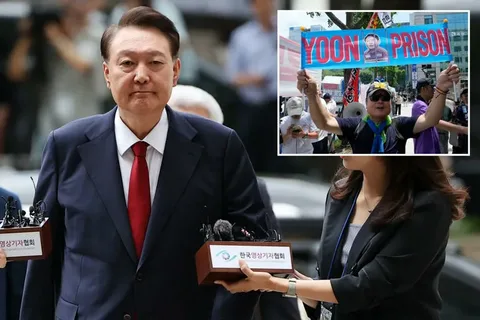
South Korea’s former president, Yoon Suk Yeol, has been sentenced to five years in prison after a court found him guilty of crimes linked to his declaration of martial law, delivering the first judicial verdict arising from one of the most serious political crises in the country’s democratic history.
The ruling was handed down by the Seoul Central District Court, which convicted Yoon Suk Yeol of abusing presidential authority, obstructing the execution of lawful duties, and manipulating official procedures connected to the attempted imposition of martial law. The court ruled that Yoon’s actions constituted a clear violation of constitutional principles and could not be justified under the emergency powers granted to a sitting president.
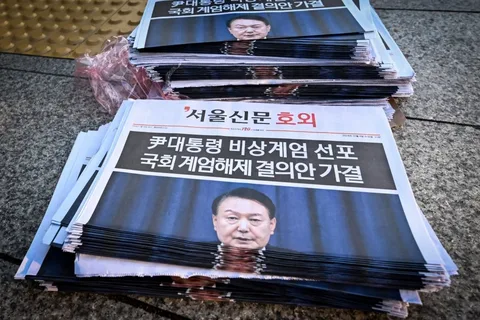
The case stems from events in December 2024, when Yoon Suk Yeol, then serving as president, abruptly announced martial law amid escalating political conflict with the National Assembly. The declaration was broadcast nationally and justified by Yoon as a necessary step to restore order and address what he described as persistent legislative obstruction by opposition lawmakers. The move triggered immediate political shock, mass public protests, and a rapid response from parliament.
Within hours of the announcement, lawmakers convened an emergency session and voted to nullify the martial law order, citing constitutional violations. The swift parliamentary rejection marked a critical turning point, effectively stripping the declaration of legal force and intensifying calls for Yoon Suk Yeol’s impeachment.
In its judgement, the court stated that Yoon Suk Yeol’s declaration of martial law lacked a lawful basis and failed to meet the strict constitutional thresholds required for such an extraordinary measure. Judges emphasised that martial law is constitutionally reserved for circumstances involving war, armed conflict, or an imminent threat to the nation’s survival, conditions that were not present at the time of the declaration.
The court further found that Yoon Suk Yeol had bypassed legally mandated procedures by failing to consult the full Cabinet before issuing the decree. Instead, he relied on a limited group of advisers, excluding several ministers whose participation was required under law. This failure, the judges ruled, rendered the declaration procedurally invalid and demonstrated a disregard for constitutional governance.
Beyond the declaration itself, Yoon Suk Yeol was also convicted of obstructing law enforcement after leaving office. Prosecutors presented evidence showing that he directed members of the Presidential Security Service to prevent investigators from executing arrest warrants related to the martial law case and other criminal allegations.
The court ruled that Yoon Suk Yeol’s use of state security personnel to block lawful arrest attempts amounted to a serious abuse of power. Judges said the actions reflected an effort to place himself above the law, undermining the foundational democratic principle that no individual is immune from legal accountability.
The verdict also addressed allegations that official documents connected to the martial law declaration had been altered or misrepresented. The court found that records surrounding the timing, approval, and execution of the declaration did not accurately reflect the actual decision-making process. Judges concluded that these discrepancies were not accidental but part of a deliberate attempt to give the unlawful action an appearance of legality.
Prosecutors had sought a longer prison sentence, arguing that Yoon’s actions posed a direct threat to constitutional order and democratic stability. While the court imposed a five-year sentence, it noted that this was only the first ruling in a broader series of criminal cases linked to the martial law episode.
Yoon Suk Yeol remains on trial in separate proceedings involving more severe charges, including allegations related to insurrection. Prosecutors in those cases are seeking significantly heavier penalties. Legal analysts note that while South Korea technically retains capital punishment in law, the country has not carried out an execution in decades, making lengthy imprisonment a more likely outcome if further convictions are secured.
The sentencing follows Yoon Suk Yeol’s impeachment and removal from office, a decision upheld by the Constitutional Court earlier in 2025. In that ruling, the court concluded that Yoon’s use of emergency powers constituted a grave breach of constitutional duty and represented an abuse of the authority entrusted to the presidency.
The impeachment of the ex-president marked a historic moment in South Korean politics. It was the first time a president was removed from office specifically over the misuse of martial law powers, reinforcing the role of institutional checks and balances in the country’s democratic framework.
After his removal, Yoon Suk Yeol initially resisted arrest, leading to a tense standoff between investigators and the Presidential Security Service. A first attempt to detain him failed after security personnel blocked access, prompting widespread criticism and concerns over the politicisation of state security institutions. A second operation, involving a large deployment of law enforcement officers, eventually resulted in his arrest.
The arrest of a former president sent shockwaves through South Korean society and highlighted the depth of the constitutional crisis triggered by Yoon Suk Yeol’s actions. It also deepened political divisions, with supporters rallying in his defence and critics insisting that accountability was essential to preserving democratic order.
During the trial, Yoon Suk Yeol’s defence team argued that he acted within his constitutional authority and that the declaration of martial law was a political decision rather than a criminal offence. They warned that prosecuting a former president for executive decisions could create a precedent that discourages decisive leadership in times of crisis.
The court rejected those arguments, stating that constitutional authority does not confer immunity from criminal law. Judges emphasised that emergency powers are subject to strict legal limits and that exceeding those limits carries legal consequences, regardless of political context.
Public reaction to the verdict has been sharply divided. Supporters of Yoon have criticised the sentence as politically motivated, while opponents have described it as a necessary affirmation of the rule of law. The case has revived public debate about South Korea’s authoritarian past, when martial law was used to suppress dissent and concentrate power in the executive.
For many South Koreans, the conviction of Yoon Suk Yeol represents a definitive rejection of any return to such practices. Civil society groups and legal scholars have argued that the ruling strengthens democratic norms by clearly defining the boundaries of presidential authority.
International observers have also closely followed the case, viewing it as a significant test of democratic resilience. The willingness of South Korean courts to prosecute and sentence a former president has been widely interpreted as evidence of judicial independence and institutional maturity.
At the same time, the prolonged legal proceedings have contributed to political uncertainty. The government that succeeded Yoon Suk Yeol has pledged to restore stability, rebuild public trust, and introduce reforms aimed at preventing a recurrence of the crisis.
Proposed reforms include clearer statutory limits on the use of emergency powers, enhanced oversight of presidential security services, and stronger mechanisms to prevent the misuse of state institutions for personal or political ends.
As Yoon Suk Yeol prepares to appeal the five-year sentence, the legal process remains ongoing. Appeals courts will reassess both factual findings and constitutional interpretations, and further verdicts in related cases could shape the final legal outcome.
Regardless of future appeals, the sentencing of Yoon has already become a defining moment in South Korea’s political history. It marks the point at which the judiciary formally ruled that the attempted use of martial law constituted criminal misconduct rather than a contested exercise of political judgement.
For South Korea, the case continues to raise fundamental questions about leadership, accountability, and the limits of power within a democratic system, questions that will continue to shape political discourse long after the final rulings are delivered.