
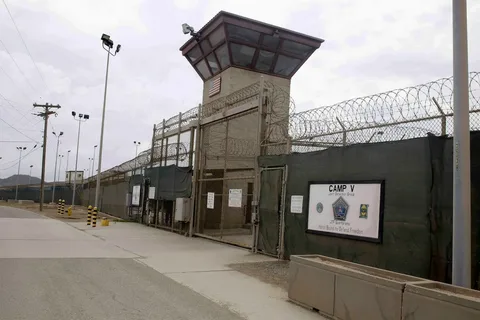
The UK government has paid a substantial financial settlement to a former Guantánamo Bay detainee who alleged that he was subjected to torture while in US custody, according to reports familiar with the matter. The payment brings to a close a long-running legal dispute involving claims of mistreatment and the alleged involvement of UK intelligence agencies.
While the exact amount has not been officially disclosed, it is understood to be significant and forms part of a confidential agreement between the claimant and the British government. The settlement does not include an admission of liability by the UK, but it represents a rare instance of financial compensation linked to the detention and treatment of an individual held at the US military facility in Cuba.
The case has revived scrutiny of the UK’s role during the post-9/11 counter-terrorism era and the extent to which British authorities were complicit, directly or indirectly, in the detention and mistreatment of terrorism suspects overseas.
Background to the detention
The former detainee was arrested abroad in the early 2000s during the height of the global counter-terrorism campaign following the September 11 attacks in the United States. Like many individuals detained during that period, he was transferred through a series of detention sites before eventually being held at Guantánamo Bay.
Guantánamo Bay was established by the United States as an offshore detention facility for terrorism suspects captured during military and intelligence operations. Detainees were held without charge or trial for extended periods, often under legal frameworks that placed them outside the protections of both US domestic law and international conventions as interpreted at the time.
The claimant alleges that during his detention he was subjected to severe mistreatment, including physical abuse and psychological coercion. These allegations form the basis of the legal action brought against the UK government, which centred on claims that British intelligence officials were aware of, contributed to, or failed to prevent his treatment.
Allegations involving UK authorities
The legal case did not focus solely on actions taken by US authorities. Instead, it examined whether UK intelligence agencies shared information, participated in interrogations, or otherwise played a role that exposed the detainee to mistreatment.
According to the claimant, UK officials were present during some stages of his detention or interrogation and failed to intervene despite knowing the conditions under which he was being held. The government has consistently denied any involvement in torture and has maintained that UK intelligence agencies operate within the law.
However, previous court proceedings in similar cases have revealed internal documents and communications that raised questions about the level of oversight exercised by British officials when working with international partners during the early years of the so-called war on terror.
The legal process
The case progressed through the UK courts over several years, marked by repeated attempts by the government to prevent sensitive intelligence material from being disclosed. Ministers argued that public hearings risked damaging national security and intelligence-sharing relationships with allies, particularly the United States.
Special closed procedures were used in parts of the litigation, allowing certain evidence to be considered by judges without being made public. Civil liberties groups have long criticised such arrangements, arguing that they limit transparency and accountability.
As the case moved closer to a full hearing, the government opted to settle. The decision to reach a financial agreement avoids a public trial and the potential release of further classified information.
Why the UK chose to settle
Settlements in cases involving national security are often driven by risk management rather than admissions of wrongdoing. By agreeing to compensation, the government avoids prolonged litigation, unpredictable court outcomes, and the possibility that damaging details could emerge under cross-examination.
Officials have previously stated that settlements are sometimes in the best interests of the taxpayer when weighed against the costs of extended legal proceedings and the broader implications for intelligence operations.
In this case, the payment is understood to be part of a confidential agreement that includes no formal apology or acceptance of responsibility. Nonetheless, the size of the settlement has drawn attention, particularly given the government’s longstanding position that UK agencies did not engage in torture.
Context of previous cases
This is not the first time the UK has faced legal action linked to Guantánamo Bay. In earlier cases, several former detainees received compensation after bringing claims that British officials were complicit in their unlawful detention and mistreatment.
Those cases prompted parliamentary inquiries and policy reviews, leading to changes in how UK intelligence agencies cooperate with foreign partners. New guidance was introduced to clarify how officers should act when there is a risk that shared intelligence could contribute to human rights abuses.
Despite these reforms, critics argue that accountability has remained limited, with few individuals facing disciplinary or criminal consequences.
Human rights implications
The settlement has renewed debate over the UK’s commitment to international human rights standards. Torture is prohibited under international law, and states are required not only to refrain from engaging in it but also to prevent complicity by their agents.
Human rights organisations have long argued that financial settlements, while providing some measure of redress to victims, do not replace the need for full public accountability. They contend that secrecy surrounding such cases undermines confidence in government assurances about ethical conduct.
Supporters of the government’s approach counter that intelligence work often involves complex partnerships in high-risk environments and that retrospective judgments must account for the context in which decisions were made.
The claimant’s position
For the former detainee, the settlement represents a formal acknowledgment that his claims were serious enough to warrant compensation. Although no admission of wrongdoing has been made, legal representatives have described the outcome as a measure of justice after years of litigation.
The claimant was eventually released from Guantánamo Bay without charge. Like many former detainees, he has faced long-term challenges reintegrating into civilian life, including reputational damage and psychological trauma associated with prolonged detention.
Broader political impact
The case has surfaced at a time when the UK continues to position itself as a defender of human rights on the international stage. Critics argue that unresolved questions about past conduct weaken that position, particularly when advocating for accountability in other countries.
Within government, the settlement is likely to reinforce a cautious approach to litigation involving intelligence agencies. It may also influence future decisions on whether to contest similar claims or seek early resolution.
What happens next
Because the settlement is confidential, further details about the payment are unlikely to be disclosed unless required by court order or parliamentary scrutiny. There are no indications that criminal proceedings will follow.
The case nonetheless adds to the historical record of legal challenges linked to Guantánamo Bay and the UK’s involvement in post-9/11 counter-terrorism operations.
As long as questions remain about accountability, transparency, and the treatment of detainees, similar cases are likely to continue shaping public debate around the balance between national security and human rights.