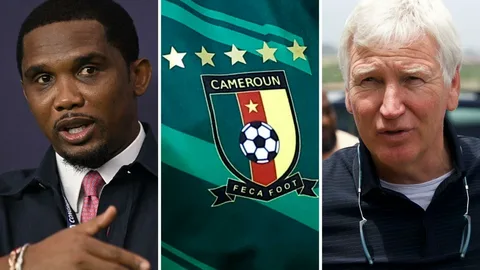
In an unprecedented twist just weeks before the 2025 Africa Cup of Nations, Cameroon has found itself at the center of a dramatic football standoff. Two completely different AFCON squad lists have been released to the public, each claiming legitimacy. The confusion stems from a power struggle between the Cameroon Football Federation, FECAFOOT, led by its president Samuel Eto’o, and national team coach Marc Brys, who insists he remains in charge despite a dismissal announcement.
The drama began when FECAFOOT issued a statement declaring that Brys had been sacked for what it described as insubordination and professional failings. The federation moved quickly to appoint David Pagou as interim coach and announced a 28-man squad. That list, however, omitted several of the country’s most established stars, including Manchester United goalkeeper André Onana, veteran striker Vincent Aboubakar and experienced forward Eric Maxim Choupo-Moting. The exclusions immediately raised eyebrows across the football community and sparked intense public debate.
Instead of stepping aside, Brys countered forcefully. He claimed he had not received any formal or legal notice of termination and therefore continued to consider himself the head coach of the Indomitable Lions. Insisting that his contract runs until September 2026, Brys released his own competing 28-man squad list, presenting it as the official AFCON 2025 selection. His version reinstated Onana, Aboubakar and other seasoned players missing from FECAFOOT’s roster. From that moment, Cameroon found itself with two men claiming to be in charge and two squads preparing for one tournament.
What initially appeared to be a routine administrative reshuffle quickly escalated into a full-blown national controversy. Brys publicly challenged FECAFOOT’s authority, stating that the sports ministry, which originally played a role in his appointment, had not endorsed any dismissal. He argued that only the state had the legal capacity to terminate his contract, and until such action was taken, he remained the lawful coach. The tension between the federation and the ministry added another layer to the escalating drama, fuelling questions about who actually governs the national team.
Eto’o, on the other hand, defended FECAFOOT’s stance. He maintained that the decision to sack Brys followed internal disagreements about team management, communication issues and what the federation viewed as the coach’s disregard for established protocols. He emphasised that all actions taken were within FECAFOOT’s legal rights. What shocked observers, however, was the speed with which the federation pushed out the new squad list and installed Pagou. To many, the move appeared reactive and politically charged, particularly given Cameroon’s failure to qualify for the 2026 World Cup, a disappointment that had already placed leadership under scrutiny.
The dual squad announcements left many players in an awkward and emotionally draining position. Some footballers found themselves named on both lists, while others appeared in only one. For those omitted from the FECAFOOT list but retained by Brys, the situation created a mixture of relief and unease. International professionals, many of whom were already preparing to report for national duty, suddenly faced uncertainty over which authority to follow. Behind the scenes, agents reportedly sought legal advice to understand which squad invitation carried actual legitimacy.
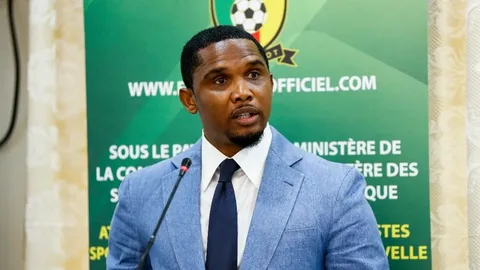
The public reaction has been equally intense. Cameroonian fans, known for their deep passion for football, have expressed frustration over what they see as needless distractions at a crucial moment. Social media platforms have been filled with heated discussions, humorous commentary, and strong criticism aimed at both FECAFOOT and Brys. Many supporters worry that the off-field chaos could affect team morale and performance during AFCON, especially as Cameroon remains one of the continent’s most decorated teams and a perennial favourite in major competitions.
Observers note that this conflict is symptomatic of broader governance tensions within African football. In several countries, national federations, sports ministries, and coaching staff often find themselves at odds over authority and decision-making. Cameroon’s case, however, stands out for its timing and severity. The release of two official team lists for a major continental tournament is virtually unheard of and raises questions that extend beyond sports. Analysts argue that the episode touches on issues of leadership, national unity and the delicate balance between political influence and sporting autonomy.
The timing could not be worse. AFCON 2025 is only weeks away, and Cameroon is expected to submit its final squad to the Confederation of African Football before the tournament deadline. CAF typically requires clarity and adherence to protocol, and the existence of two competing lists could force the governing body to intervene. A failure to present a unified, uncontested squad may carry consequences ranging from administrative sanctions to reputational damage.
Behind closed doors, negotiations are reportedly ongoing among FECAFOOT officials, government representatives and stakeholders aligned with Brys. The goal, at least publicly, is to settle the matter amicably and ensure that the Indomitable Lions can focus on preparations rather than politics. However, the personal dynamics between Eto’o and Brys, both of whom have made strong public statements, make the path to resolution uncertain. Each side appears convinced of its legitimacy and has shown little willingness to concede.
The implications for the players extend beyond AFCON. The national team has been attempting to rebuild after its World Cup qualification failure, using the 2025 tournament as an opportunity to restore pride and re-establish its continental dominance. Instead, the focus has shifted to administrative battles, with questions now being asked about long-term leadership, team strategy and the future of both the coach and the federation president.
Despite the turmoil, many Cameroonians remain hopeful that unity will prevail before the tournament begins. Football has a unique power to bring the nation together, and AFCON historically serves as a unifying moment for supporters across the country. The desire among fans is for the authorities involved to set aside personal grievances and prioritise national interest. The players too, who have voiced their concerns privately, are reportedly eager for clarity so they can concentrate on competing at the highest level.
As AFCON 2025 approaches, all eyes remain on Cameroon. The country now stands at a crossroads, with two squads, two leaders, and one rapidly approaching deadline. The situation is a stark reminder of how internal politics can overshadow sporting ambitions and how unity, or the lack of it, can determine a nation’s success on the continental stage.
Whether Cameroon resolves the controversy swiftly or continues down this path of internal division may very well shape the team’s performance and reputation for years to come. For now, the only certainty is that the nation will need to choose a single squad and a single leader, and do so before the first whistle in Morocco.